
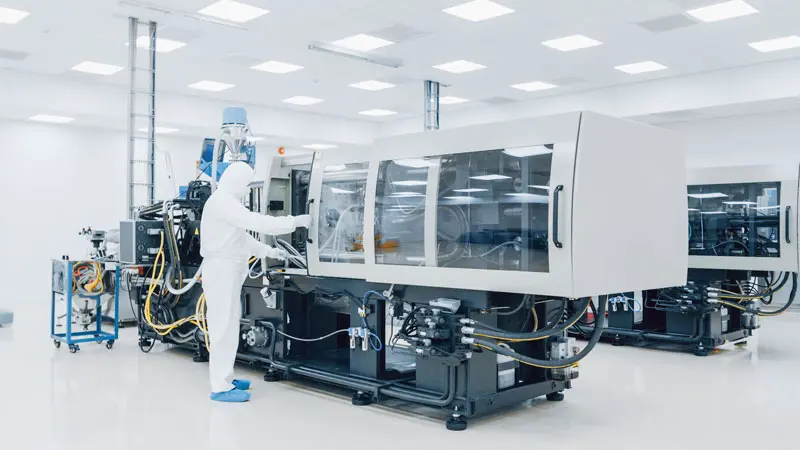
Clean room injection molding does not announce itself. The devices it produces, catheters, drug delivery components, diagnostic cartridges, surgical instrument housings, arrive in hospitals and clinics in sealed sterile packaging, their manufacturing origins invisible to the clinician opening them. But the conditions under which those devices were made matter enormously. A component moulded in an uncontrolled environment carries contamination risks that no downstream sterilisation process can fully eliminate. The compliance framework governing cleanroom injection moulding exists because the consequences of ignoring those risks do not stay inside the factory. They follow the product.
The Compliance Architecture
The regulatory requirements that define clean room moulding for medical devices draw from several intersecting standards, each addressing a different dimension of contamination control and quality assurance.
ISO 14644-1 establishes the classification system for cleanroom environments, defining maximum permitted airborne particle concentrations across a scale from ISO Class 1 to ISO Class 9. For most cleanroom injection moulding operations producing medical device components, ISO Class 7 and Class 8 are the working classifications. ISO Class 7 permits no more than 352,000 particles of 0.5 microns or larger per cubic metre. Class 8 permits up to 3,520,000 at the same particle size. Where sterile assembly or open product exposure demands the strictest control, ISO Class 5 applies.
ISO 13485 governs the quality management system within which cleanroom moulding operations must be embedded. It requires documented process controls, validated production methods, traceability from raw material to finished device, and a post-market quality system capable of investigating field complaints and implementing corrections. ISO 14644-2 addresses the ongoing monitoring and re-qualification obligations that keep a classified environment performing to its specification after initial certification.
For facilities supplying the United States market, FDA 21 CFR Part 820 imposes additional requirements around process validation, device history records, and corrective and preventive action systems. EU MDR conformity, assessed by a notified body, adds clinical evidence and post-market follow-up obligations for programmes targeting European distribution.
Singapore’s clean room injection moulding manufacturers operate under this full compliance architecture, holding ISO 13485 certification and maintaining quality systems aligned with both FDA and EU MDR requirements. The Health Sciences Authority’s regulatory framework, aligned with global standards, provides the national oversight layer within which those facilities are inspected and their compliance verified.
Process Benefits That Compliance Delivers
It would be a mistake to treat the compliance requirements governing clean room injection molding purely as regulatory overhead. The controls that satisfy regulators also deliver measurable process benefits that improve both product quality and production economics over time.
Operating in a classified environment imposes a rigour absent from standard moulding operations. Gowning requirements reduce the human-sourced contamination that causes surface defects on moulded parts. Controlled humidity prevents moisture absorption by hygroscopic resins during storage and processing, reducing the splay, voids, and mechanical property degradation that moisture contamination produces in the finished part. Temperature control stabilises the viscosity of the polymer melt, improving shot-to-shot consistency and dimensional repeatability across the production run.
The process benefits of controlled environment injection moulding include:
Reduced particulate defects
Filtered air supply and controlled surfaces minimise the foreign particle inclusions that cause visual rejects and functional failures in precision-moulded components
Improved dimensional consistency
Stable temperature and humidity conditions reduce the environmental variability that contributes to dimensional drift over the course of a production shift
Lower microbial bioburden
Cleanroom disciplines reduce the microbial contamination on moulded surfaces, lowering the bioburden load that sterilisation processes must address and improving sterility assurance levels for terminally sterilised devices
Better material performance
Moisture-controlled resin handling preserves the molecular weight and mechanical properties of moisture-sensitive engineering polymers, producing parts that meet their strength and flexibility specifications consistently
Documented process traceability
The environmental monitoring records, batch documentation, and equipment logs generated within a compliant cleanroom operation create a complete audit trail that supports regulatory submissions and investigation of field complaints
Equipment and Layout Decisions That Determine Outcome
The compliance benefits of cleanroom injection moulding are not automatic. They depend on equipment specifications and facility layout decisions that must be made correctly from the outset and maintained through the operational life of the facility.
All-electric injection moulding machines are the preferred specification for classified environments. They eliminate the hydraulic fluid emissions that contaminate both the air and the moulded parts in conventionally driven machines. Their servo-driven axes provide superior repeatability that compounds with cleanroom environmental stability to produce tighter process capability than hydraulic machines achieve in standard conditions.
Airflow design determines whether the classified environment protects the product or merely surrounds it. Unidirectional downward airflow from ceiling-mounted HEPA filter units, directed across the mould and parts handling area toward floor-level exhaust, sweeps particles away from the critical zone. Turbulent or inadequate airflow can create stagnant areas where contamination accumulates rather than being continuously purged.
Material handling must prevent resin exposure to unfiltered air. Closed drying and conveying systems that transfer material directly from storage to the press reduce both moisture pickup and particulate contamination during loading.
Why the Investment Is Justified
The cost of establishing and operating a compliant cleanroom moulding environment is real and measurable. Facility construction, air handling infrastructure, environmental monitoring programmes, and the qualification and re-qualification studies required to maintain certification all represent ongoing expenditure that standard moulding operations do not carry.
What that investment buys is verifiable process control, documented in a form that regulators, notified bodies, and customer audit teams can independently assess. In a sector where product failures carry clinical consequences, that documentation is the evidence base on which a manufacturer’s standing depends. For devices made for the human body, the case for clean room injection molding is both a compliance argument and a patient safety one.

Comments are closed.