
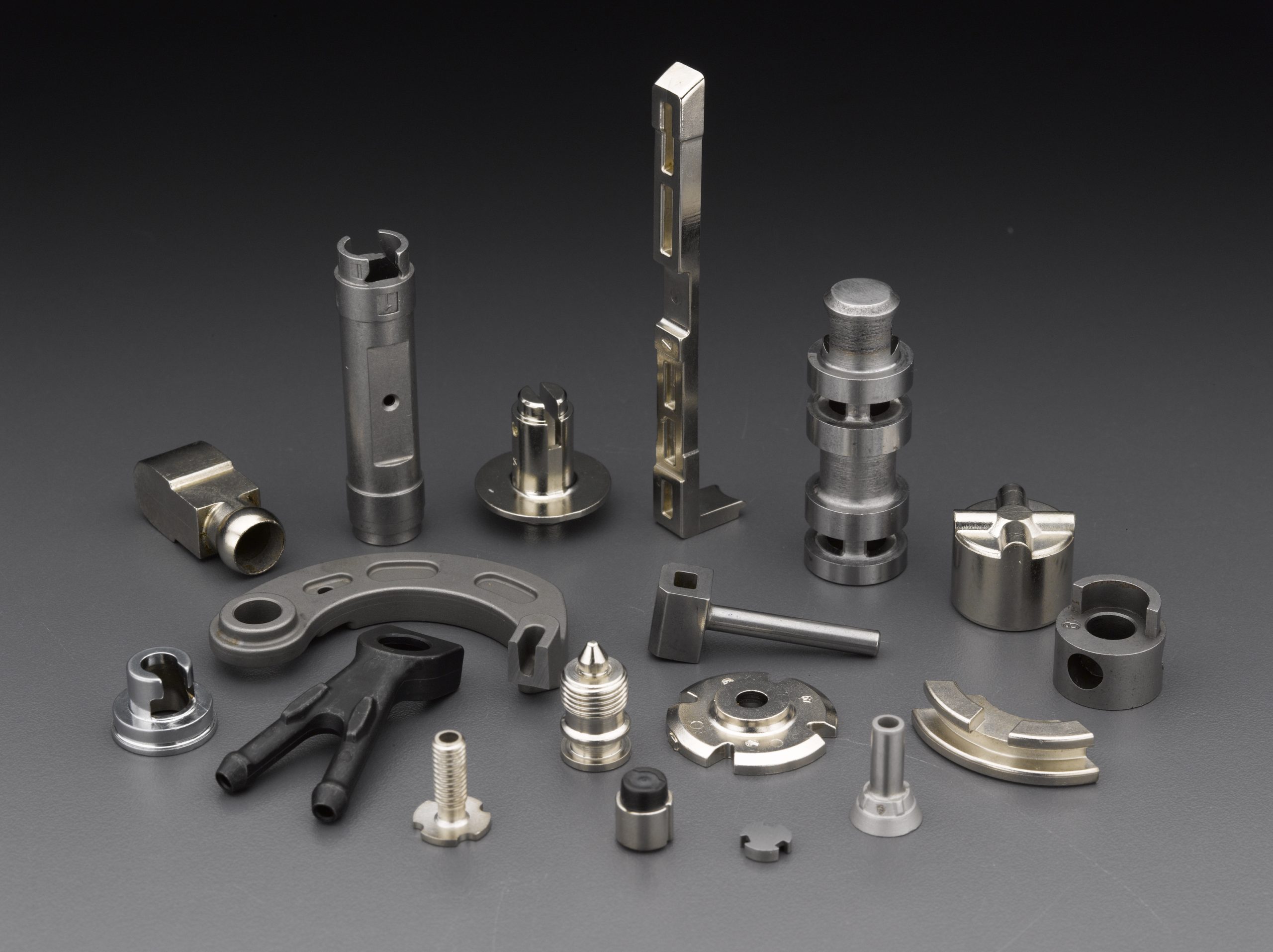
In the hierarchy of modern metalworking techniques, MIM manufacturing occupies a peculiar and somewhat unlikely position, having emerged from the shadows of traditional processes to claim advantages that once seemed mutually exclusive: exceptional strength combined with remarkable economy. The story of Metal Injection Moulding reads like that of many industrial innovations, born from a simple observation that particles of metal, when fine enough and properly bound, might flow like thermoplastics before transforming back into their metallic nature. What began as experimental work in the 1970s has evolved into a sophisticated manufacturing process that challenges fundamental assumptions about the relationship between component complexity and production cost.
The Strength Proposition
The mechanical properties of metal injection moulding components tell a story of density and uniformity that traditional powder metallurgy struggles to match. Where pressed and sintered parts might achieve 85 to 90 per cent of theoretical density, MIM parts routinely reach 96 to 98 per cent, approaching the density of wrought metals. This difference matters profoundly when components face mechanical stress, cyclic loading, or harsh environmental conditions.
Consider the grain structure that emerges from the sintering process. As metal particles fuse at temperatures approaching their melting point, they form a microstructure remarkably similar to cast or wrought metals. The fine powder feedstock, with particles measuring less than 20 microns, produces a finished grain structure finer than many conventional metalworking processes achieve. This refinement translates directly into mechanical advantage:
- Tensile strengths exceeding 1,000 MPa in certain stainless steel alloys
- Yield strengths comparable to machined components from bar stock
- Elongation percentages that permit some degree of plastic deformation before failure
- Fatigue resistance suitable for components experiencing cyclical loading
The uniformity of properties throughout the component distinguishes MIM technology from processes where material characteristics vary by location. A machined part inherits the directionality of the original billet or forging. A MIM component exhibits isotropic properties, performing equally well regardless of stress direction.
The Economic Architecture
Here lies perhaps the most compelling narrative of metal injection moulding: the inversion of traditional manufacturing economics. Conventional wisdom holds that complexity costs money. Each additional feature, each undercut, each internal channel adds machining time, tool wear, and potential for error. MIM production operates according to different logic entirely.
Once tooling exists, a component with six internal channels and multiple undercuts requires essentially the same production time as a simple cylinder. The injection cycle proceeds identically. The debinding and sintering schedules remain unchanged. Labour input stays constant. This characteristic allows designers to optimise components for function rather than manufacturing convenience, adding features that improve performance without proportionally increasing cost.
The mathematics become increasingly favourable with volume. Initial tooling investment, whilst substantial, amortises across production runs. At 10,000 units, the per-part tooling cost might represent 20 per cent of total manufacturing expense. At 100,000 units, that percentage drops to 2 per cent or less. Meanwhile, alternative processes see costs climb with each additional unit, each requiring dedicated machine time and operator attention.
Singapore’s Manufacturing Excellence
Singapore’s MIM manufacturing sector exemplifies how regional expertise develops around demanding applications. The concentration of medical device production in the city-state has driven MIM capabilities toward extraordinary precision. Components for surgical instruments, where dimensional tolerances of plus or minus 0.05 millimetres determine functionality, emerge from Singapore facilities with consistent reliability.
The clean room environments maintained there speak to understanding that contamination represents not merely a quality concern but a fundamental threat to process control. A single dust particle trapped in a green part can create a defect that survives through debinding and sintering, appearing in the final component as a density anomaly or surface imperfection. Singapore manufacturers address this through environmental controls that rival semiconductor fabrication facilities.
Material Flexibility and Performance
The catalogue of alloys suitable for metal injection moulding reads like a metallurgist’s wish list. Stainless steels in various grades, titanium alloys for biomedical applications, cobalt-chromium for wear resistance, tungsten heavy alloys for radiation shielding, each brings distinct properties to finished components:
- 316L stainless steel offering corrosion resistance for marine environments
- 17-4PH stainless providing high strength after precipitation hardening
- Ti-6Al-4V titanium combining strength with biocompatibility
- Inconel 718 delivering performance at elevated temperatures
This material versatility permits engineers to select alloys based on service requirements rather than manufacturing constraints. A component requiring both high strength and corrosion resistance can be produced in 17-4PH stainless without the extensive machining time that alloy’s hardness would normally demand.
Design Freedom as Competitive Advantage
The geometric possibilities of MIM processes extend beyond mere complexity to encompass features that conventional manufacturing cannot economically produce. Internal threads, cross-holes, varying wall thicknesses within a single component, surface textures moulded directly into parts rather than added through secondary operations. These capabilities collapse assembly steps, eliminating fasteners and reducing component count.
Weight optimisation becomes achievable through selective material placement. Where a machined component must maintain stock thickness throughout, a MIM component can vary wall thickness by 50 per cent or more within the same part, placing material only where structural analysis indicates necessity. Aerospace and medical device applications particularly value this characteristic, where every gramme removed represents fuel savings or reduced patient burden.
The Consolidation of Manufacturing Steps
Perhaps no advantage of metal injection moulding proves more valuable than the reduction in process steps. A conventionally manufactured component might require rough machining, heat treatment, finish machining, surface grinding, and final inspection. The same component produced through MIM technology might emerge from sintering requiring only minimal deburring before final inspection. This consolidation reduces handling, limits work-in-process inventory, and minimises opportunities for dimensional drift or contamination.
Looking Forward
The advantages inherent in MIM manufacturing position the technology for continued expansion into applications where strength, complexity, and cost constraints once forced uncomfortable compromises. As industries demand lighter components without sacrificing performance, as geometries grow more intricate to optimise function, the case for MIM manufacturing strengthens correspondingly.

Comments are closed.