
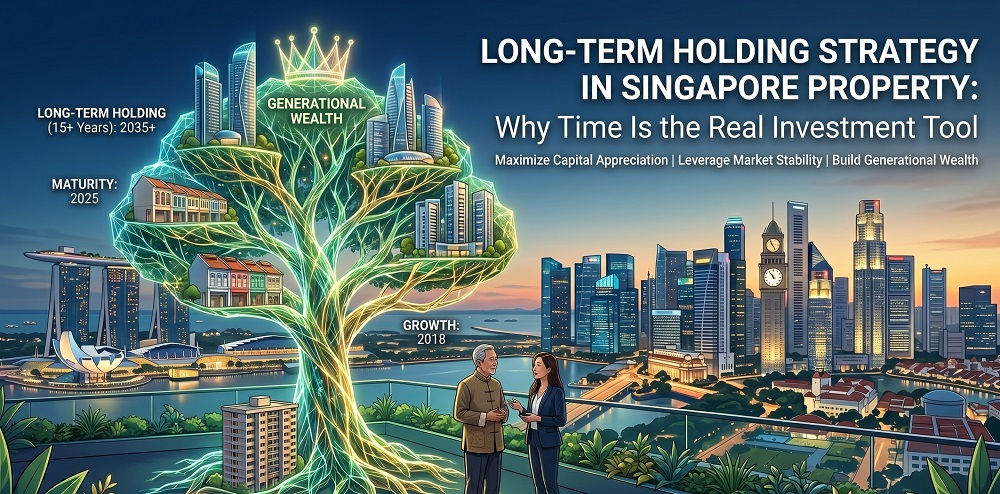
In Singapore’s property market, many investors focus heavily on entry timing, exit timing, and short-term cycles. But the most consistent wealth creation often comes from something far less dramatic: holding quality assets over a long period of time.
Long-term holding is not passive. It is a deliberate strategy that leverages time, compounding, and structural market stability.
Why Long-Term Holding Works in Singapore
Singapore’s property market is uniquely suited for long-term investment strategies due to its structural characteristics:
- Controlled land supply
- Strong regulatory framework
- Stable economic fundamentals
- Consistent housing demand
These factors reduce extreme volatility and allow value to accumulate gradually over time rather than through sharp speculative cycles.
The Power of Compounding Through Property
Unlike many financial assets, property compounds in multiple ways:
- Capital appreciation over time
- Rental income accumulation
- Debt reduction through loan repayment
- Inflation-driven value adjustment
Each component contributes to long-term wealth growth. The longer the holding period, the more these effects compound.
Why Short-Term Thinking Often Underperforms
Short-term strategies in property investing often struggle because transaction costs are high and timing is difficult.
Buying and selling frequently can result in:
- Stamp duties and transaction fees eating into profits
- Missed appreciation cycles due to early exits
- Increased exposure to market timing risk
In contrast, long-term holding reduces the impact of short-term fluctuations.
The Role of Location in Holding Strategy
Not all properties are equally suited for long-term holding. Location quality plays a critical role in sustaining demand and value over time.
Strong locations tend to:
- Maintain rental demand across cycles
- Recover faster during downturns
- Attract consistent buyer interest
Developments like Thomson Reserve reflect this principle, where long-term locational strength supports sustained value retention.
Weathering Market Cycles
Even in a stable market like Singapore, cycles still exist. Prices may slow, stabilize, or grow at different rates depending on economic conditions.
Long-term holding allows investors to:
- Ride out downturns without forced selling
- Benefit from recovery phases
- Avoid emotional decision-making during volatility
Time in the market smooths out these cycles.
Rental Income as a Holding Support System
Rental income plays a key role in making long-term holding viable. It helps offset holding costs such as:
- Mortgage payments
- Maintenance fees
- Property taxes
When managed properly, rental income can support neutral or even positive cash flow over time, reducing financial pressure.
The Importance of Financing Structure
Long-term holding requires sustainable financing. Over-leveraging can force premature exits during unfavorable conditions.
A balanced financing structure allows investors to:
- Ride out interest rate changes
- Maintain flexibility during downturns
- Avoid forced liquidation
Holding power is as much about financial planning as it is about property selection.
Lifestyle Demand and Long-Term Stability
Properties with strong lifestyle appeal tend to perform better over long holding periods because they remain desirable across different buyer and tenant cycles.
For example, areas such as Amberwood at Holland benefit from consistent lifestyle-driven demand, which supports long-term rental stability and resale interest.
This reduces the risk of obsolescence over time.
The Psychological Challenge of Holding
Long-term holding is simple in theory but difficult in practice.
Common psychological challenges include:
- Fear of missing out on other opportunities
- Temptation to take short-term profits
- Frustration during slow market periods
- Comparison with faster-moving assets
These emotional pressures often lead investors to exit too early.
Opportunity Cost vs Holding Discipline
One of the main arguments against long-term holding is opportunity cost—capital could potentially be used elsewhere for higher returns.
However, this assumes:
- Better opportunities are consistently available
- Timing new investments is accurate
- Transaction costs are minimal
In reality, consistent reinvestment timing is difficult, which is why holding quality assets often remains competitive.
When Long-Term Holding Works Best
Long-term holding is most effective when:
- The property is in a strong, established location
- Rental demand is stable
- Financing is manageable
- The asset is fundamentally well-designed
In these conditions, time becomes a powerful advantage rather than a burden.
Portfolio-Level Thinking
Long-term holding does not need to apply to every property in a portfolio.
Many investors adopt a mixed approach:
- Core assets held long-term for stability
- Secondary assets used for repositioning or exit strategies
This allows flexibility while still benefiting from compounding.
Final Perspective
Long-term holding is one of the most reliable strategies in Singapore property investing, but it requires discipline, patience, and strong asset selection.
It is not about ignoring market cycles, but about reducing dependence on them.
In a market designed for stability and gradual growth, time is often the most underrated investment tool. Those who commit to holding well-chosen assets through cycles are usually the ones who benefit most from the market’s long-term structure.

Comments are closed.