
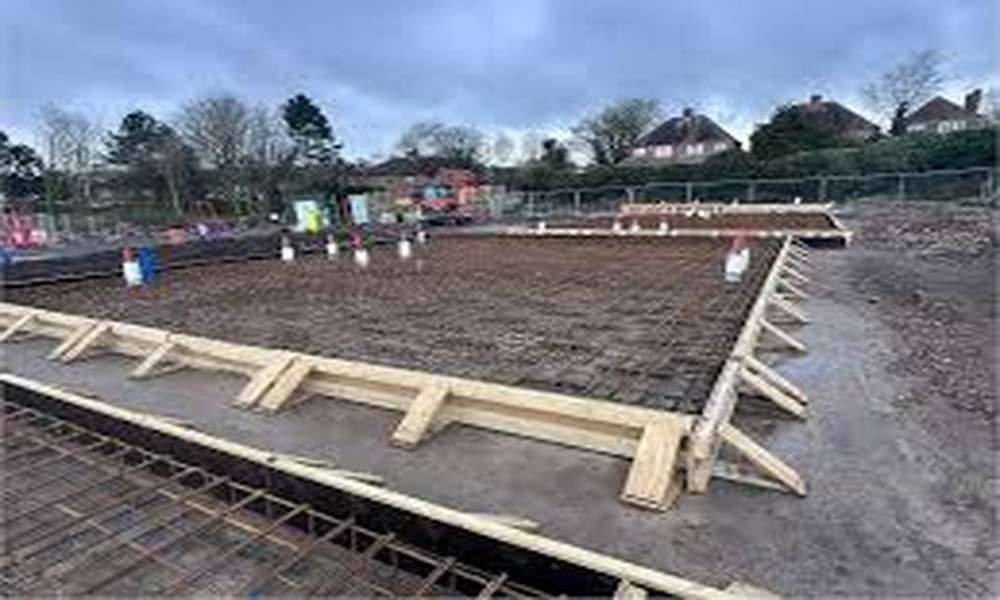
When constructing any building, the foundation plays a critical role in ensuring stability, durability, and safety. However, not all construction sites offer ideal soil conditions. In many cases, engineers must deal with weak, compressible, or highly variable soils that cannot safely support traditional foundation systems. This is where raft foundations emerge as a practical and efficient solution.
What is a Raft Foundation?
A raft foundations, also known as a mat foundation, is a large reinforced concrete slab that supports the entire building by distributing its load over a wide area. Instead of having individual footings beneath each column or wall, a raft foundation spreads the structural load across the entire footprint of the building.
Why Raft Foundations Are Used
Raft foundations are particularly useful in situations where:
- The soil has low bearing capacity (such as clay or loose sand)
- Soil conditions vary significantly across the site
- The water table is high
- Columns are closely spaced
- The building load is heavy
By spreading the load, raft foundations reduce pressure on the soil and help prevent excessive settlement.
How Raft Foundations Work
The working principle of a raft foundation is based on load distribution. By covering a large surface area, the pressure exerted on the soil is reduced. This minimizes the risk of differential settlement, where different parts of a building sink at different rates.
In simple terms, it works like a wide platform that “floats” on the soil, ensuring that the building remains stable even if the ground beneath is not uniform.
Types of Raft Foundations
1. Solid Slab Raft
A flat slab of uniform thickness, suitable for relatively light structures and moderately weak soils.
2. Beam and Slab Raft
Includes beams integrated into the slab to increase stiffness and load-bearing capacity.
3. Cellular Raft
Consists of a grid of beams forming hollow spaces, ideal for very heavy loads and poor soil conditions.
4. Piled Raft Foundation
Combines a raft with piles to transfer some load to deeper, stronger soil layers.
Advantages of Raft Foundations
- Even distribution of structural loads
- Reduced risk of differential settlement
- Suitable for weak and expansive soils
- Faster construction for large structures
- Can act as a ground floor slab, reducing construction steps
Limitations of Raft Foundations
- Higher consumption of concrete and reinforcement
- Requires careful design and engineering expertise
- Not always economical for small buildings
Raft Foundation vs Traditional Footings
Traditional isolated footings concentrate loads at specific points, making them suitable for strong and stable soils. In contrast, raft foundations distribute loads evenly, making them more suitable for weak or inconsistent soil conditions.
Practical Example
Consider a commercial building planned on soft clay soil. If isolated footings are used, some parts of the structure may settle more than others, leading to cracks and long-term structural issues. A raft foundation mitigates this risk by acting as a single unified base, ensuring uniform settlement and improved stability.
Conclusion
Raft foundations are an intelligent engineering solution for construction on weak or variable soils. By distributing loads evenly and minimizing settlement issues, they provide a stable and durable base for a wide range of structures.
Before selecting a foundation type, it is essential to conduct a proper geotechnical investigation. Understanding the soil conditions will help engineers choose the most effective and economical foundation system for the project.

Comments are closed.